
ENVIRONMENTAL MONITORING
More obligations, less coverage, and growing gaps.
NIRA provides continuous, in-situ ocean intelligence — bridging the gap between what regulators demand and what existing monitoring methods can deliver.
Talk to Us
THE CHALLENGE
Regulators need more. Existing methods deliver less.
Temporal Resolution Too Low
Most monitoring programmes run monthly, quarterly or annually. Harmful algal blooms, acute pollution events, and hypoxic episodes develop within hours — long before the next scheduled sample.
Coverage Gaps in MPAs and Offshore
Less than 30% of EU MPAs have adequate monitoring for the habitats they were designated to protect (EC JRC, 2024). Fixed infrastructure clusters near ports — offshore, open coastal, and MPA interiors are severely under-sampled.
Methods Are Expensive and Slow
Research vessels cost £10k–£50k/day. Lab turnaround takes 2–8 weeks. Satellite imagery has a 2–5 day revisit cycle and misses sub-surface conditions entirely. No current method delivers real-time, in-situ, wide-area data affordably.
<30%
EU MPAs with adequate monitoring
8 weeks
Typical lab turnaround time
£50k/day
Research vessel day rate
5 days
Satellite revisit cycle — no sub-surface
HOW NIRA HELPS
Continuous. In-situ. Affordable.
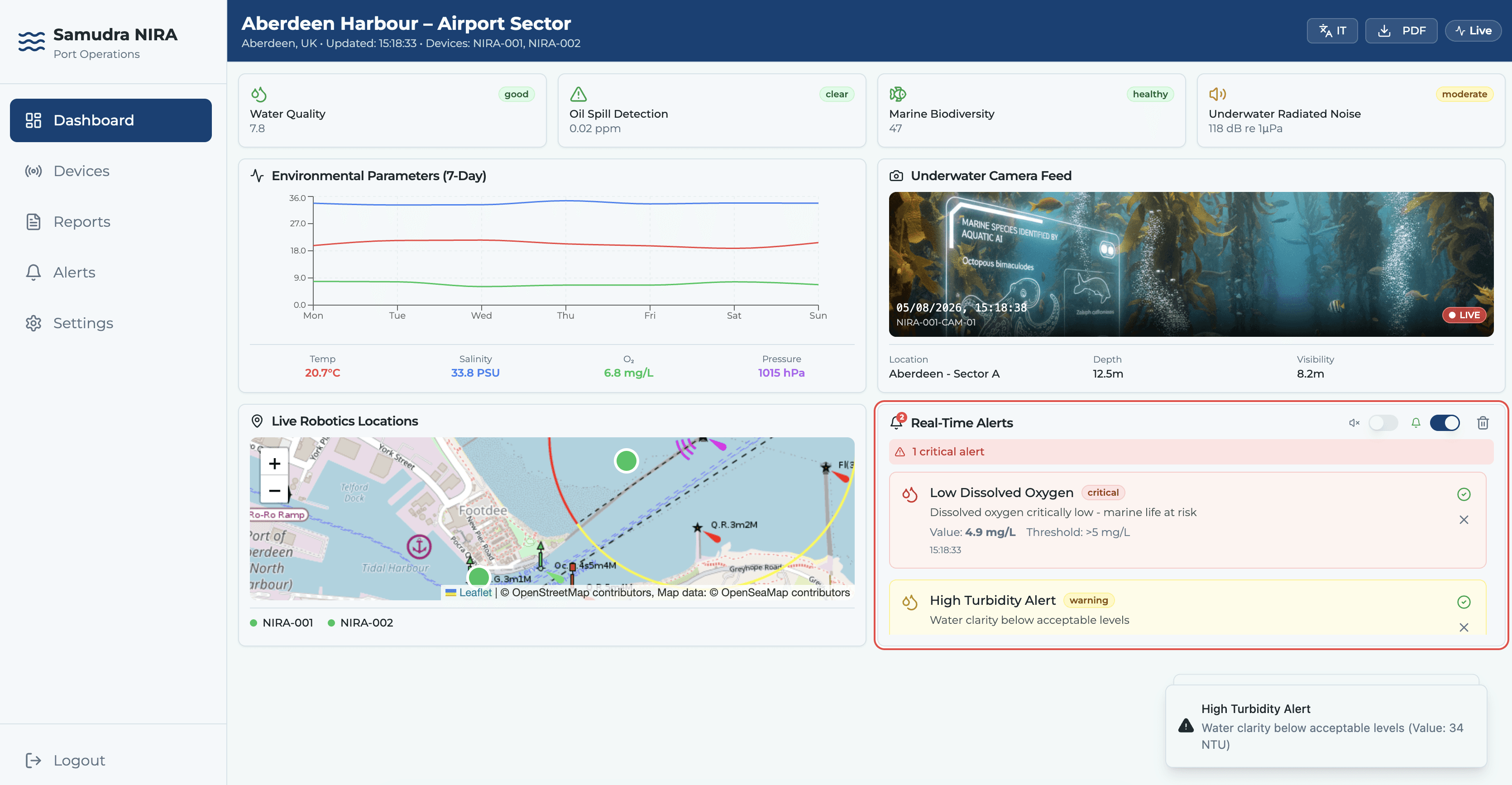
NIRA closes the gaps that research vessels, satellite imagery, and periodic sampling cannot — with persistent, autonomous sensing that delivers data in real time.
→ Real-time detection of harmful algal blooms, hypoxic zones, and acute pollution events — hours not weeks
→ Continuous monitoring of WFD/MSFD parameters: temperature, DO, pH, nutrients, chlorophyll-a, turbidity
→ Fills spatial gaps in MPAs, open coastal waters, and offshore zones where fixed infrastructure does not reach
→ Supports eDNA, microplastics, and emerging contaminant monitoring — parameters with no current affordable solution
KEY METRICS
The cost of inadequate monitoring is measurable.
$82m
US annual HAB economic losses
NOAA estimates harmful algal blooms cost the US economy $82m/year in direct losses — fishing, tourism, public health. EU single-event losses run £10–30m. All from events that monitoring would have caught earlier.
£500m
Offshore pollution clean-up costs
Significant offshore pollution events routinely cost £50–500m in clean-up and compensation. Without pre-incident baseline data, liability attribution is contested and settlements escalate.
£1–5m
Bathing water failure cost per closure
A single Red Flag bathing water closure in peak season costs a coastal local authority £1–5m in lost tourism revenue. Continuous real-time monitoring enables early warning and prevention.
RELEVANT REGULATIONS
A converging set of obligations — and tightening deadlines.
EU Water Framework Directive
Requires Good Ecological Status for all coastal and transitional waters. Mandates surveillance, operational and investigative monitoring programmes. Post-2027 revision under way.
EU Marine Strategy Framework Directive
11 Good Environmental Status descriptors across the full EEZ. Next reporting cycle 2024/25. Descriptors 5 (eutrophication), 8 (contaminants) and 11 (noise) are the most measurement-intensive.
Habitats and Birds Directives
Require monitoring and maintenance of Favourable Conservation Status for Natura 2000 sites. Article 17 reports every 6 years. Less than 30% of EU MPAs currently meet adequate monitoring standards.
EU Bathing Waters Directive
Weekly sampling required at designated bathing waters in season. Results must be published. Failures trigger mandatory public notifications and can lead to bathing water delisting.
UK Marine and Coastal Access Act 2009
Established the MMO and UK Marine Protected Areas. Monitoring obligations for MPA condition assessment are a statutory requirement. Enforced by OEP post-Brexit.
UN Ocean Decade 2021–2030
IOC-UNESCO mandate for sustained ocean observations globally. Drives national funding commitments and monitoring programme expansions across GOOS, IOC, and national agencies.
Talk to us about your monitoring obligations.
Whether you are an environmental agency, port authority, consultancy, or MPA manager — NIRA can be deployed to fill the gaps your current methods cannot reach.
Get in Touch